
What Is GEO? How to Optimize Your Website for AI Search
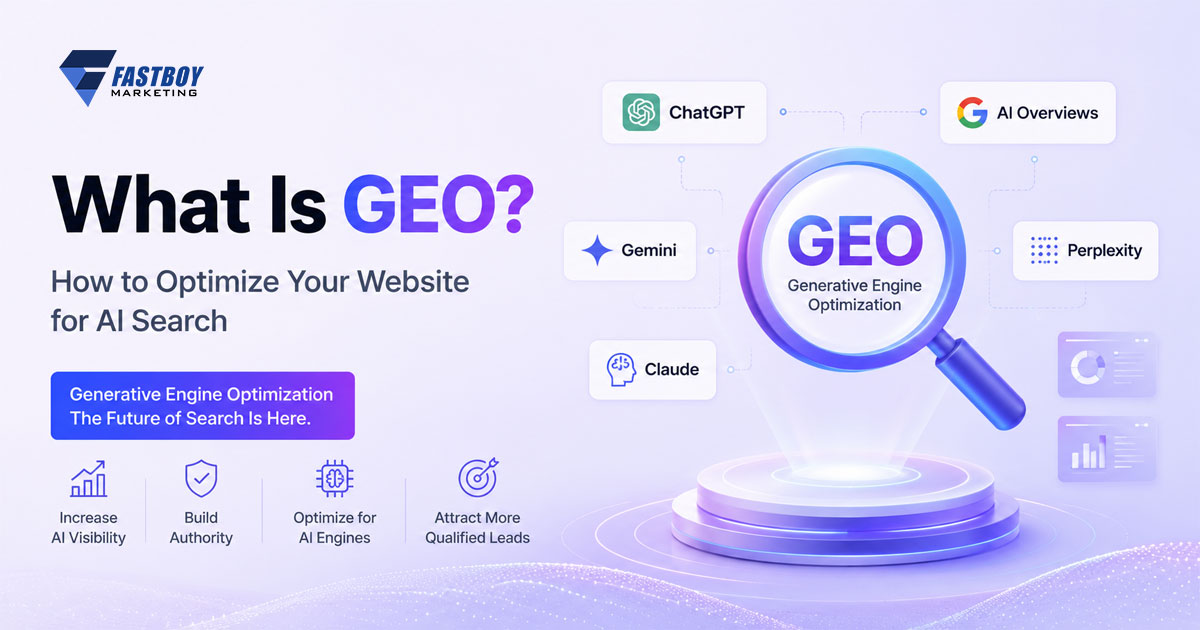
What Is GEO? How to Optimize Your Website for AI Search
Artificial Intelligence is transforming how people search for information online. Instead of typing short keywords into Google, users are increasingly asking complete questions in AI-powered search engines such as ChatGPT, Google AI Overviews, Gemini, Claude, and Perplexity.
Rather than displaying a list of websites, these platforms generate direct answers by analyzing trusted sources across the web. This shift has created a new optimization strategy known as Generative Engine Optimization (GEO).
For businesses, GEO represents the next evolution of digital marketing. Ranking on Google is still important, but being recommended by AI has become just as valuable. Companies that adapt early will gain a significant competitive advantage as AI search continues to grow.
At Fastboy Marketing, we believe the future of search isn't SEO or GEO—it's SEO and GEO working together. That's why we incorporate GEO strategies into our SEO campaigns to help businesses increase visibility across both traditional search engines and AI-powered platforms.
What Is GEO?
Generative Engine Optimization (GEO) is the process of optimizing your website so AI-powered search engines can understand, trust, and reference your content when generating answers for users.
Unlike traditional SEO, which focuses on improving rankings in search engine results pages (SERPs), GEO focuses on increasing the likelihood that AI assistants will cite your website as a reliable source.
Imagine a potential customer asking ChatGPT:
"Which marketing agency specializes in SEO for nail salons?"
Instead of presenting ten blue links like a traditional search engine, the AI provides a summarized answer based on websites it considers authoritative. If your website demonstrates expertise, trustworthiness, and topical authority, your business has a much better chance of being included in that response.
This is exactly where GEO creates value.
Why GEO Matters More Than Ever
The way people search is changing rapidly. Millions of users now rely on AI assistants to answer questions, compare products, and discover local businesses.
This means businesses need to optimize for two audiences:
- Traditional search engines like Google and Bing.
- AI-powered search experiences such as ChatGPT, Google AI Overviews, Gemini, and Perplexity.
Companies that focus only on keyword rankings may miss opportunities to appear in AI-generated answers. GEO helps bridge that gap by making your content easier for AI models to understand, verify, and reference.
For service-based businesses—including marketing agencies, healthcare providers, law firms, restaurants, and nail salons—this can significantly increase brand visibility before a customer even visits a search results page.
GEO vs. SEO: What's the Difference?
Although GEO and SEO share many best practices, they serve different purposes.
Understanding the differences between SEO and GEO helps businesses prepare for the future of search.
The most important thing to understand is that GEO does not replace SEO.
Without strong SEO, search engines may struggle to crawl and index your website. Without GEO, AI platforms may understand your content but still choose another website as a more authoritative source.
Businesses that combine both strategies are better positioned for the future of search.
How AI Search Engines Evaluate Content
AI platforms don't simply copy information from websites. Instead, they analyze multiple trusted sources, compare facts, identify patterns, and generate original responses.
To determine which websites deserve to be referenced, AI systems often look for signals such as:
- High-quality, original content.
- Demonstrated expertise on a topic.
- Strong website authority.
- Structured content with clear headings.
- Consistent brand information across the web.
- Technical SEO best practices.
- Structured data (Schema Markup).
- Positive reputation and trust signals.
These principles closely align with Google's EEAT framework—Experience, Expertise, Authoritativeness, and Trustworthiness.
At Fastboy Marketing, we build every SEO strategy around these principles because they benefit both traditional search engines and the latest AI-powered search experiences.
In the next section, we'll explore practical strategies you can use to optimize your website for GEO, along with how Fastboy Marketing helps businesses prepare for the future of AI search.
How to Optimize Your Website for GEO
Optimizing for Generative Engine Optimization requires a broader strategy than simply targeting keywords. AI search engines evaluate whether your website is a trustworthy source of information, not just whether it contains the right phrases.
A successful GEO strategy combines semantic content, entity SEO, structured data, EEAT, and technical optimization
Here are the most effective GEO strategies businesses should implement today.
1. Create Topically Comprehensive Content
Instead of publishing short articles that target a single keyword, focus on creating comprehensive resources that answer multiple related questions within one topic.
For example, rather than writing only one article about SEO, build an entire content hub that covers topics such as:
- What Is SEO?
- What Is GEO?
- Local SEO Guide
- Technical SEO Best Practices
- Google Business Profile Optimization
- AI Search Optimization
- Content Marketing Strategies
This approach helps AI understand that your website has deep expertise within a specific industry.
At Fastboy Marketing, every content strategy begins with topical authority. Rather than chasing individual keywords, we develop interconnected content clusters that demonstrate expertise across an entire subject.
2. Build Strong Entity SEO
Modern AI systems understand brands, people, organizations, and services as entities rather than isolated keywords.
To improve GEO performance, ensure your business information remains consistent across your website and the web.
Important entity signals include:
- Company name
- Business description
- Services
- Social media profiles
- Business location
- Organization Schema
- Contact information
- Author profiles
The stronger your digital entity, the easier it becomes for AI platforms to recognize your brand as an authoritative source.
3. Use Structured Data (Schema Markup)
Schema Markup helps search engines and AI understand the context of your content.
Recommended Schema types include:
- Organization
- Article
- Service
- Local Business
- Breadcrumb
- FAQ
- Review
- Author
Although Schema does not directly improve rankings, it improves how search engines interpret your content, making it easier for AI systems to extract accurate information.
4. Strengthen Internal Linking
Internal links help AI understand the relationship between different pieces of content.
Instead of publishing standalone articles, connect related topics together.
For example:
- What Is GEO?
- GEO vs SEO
- Technical SEO Checklist
- Local SEO Guide
- Content Marketing Strategy
- Google Business Profile Optimization
This creates a semantic network that strengthens topical authority and improves user experience.
5. Demonstrate Real Experience (EEAT)
Google and AI search platforms increasingly prioritize content created by people with genuine expertise and experience.
Your website should clearly demonstrate:
- Real-world experience
- Industry knowledge
- Professional credentials
- Case studies
- Customer success stories
- Testimonials
- Updated content
- Transparent author information
Businesses that consistently publish helpful, experience-based content are significantly more likely to become trusted AI references.
How Fastboy Marketing Implements GEO
At Fastboy Marketing, we view GEO as the natural evolution of SEO rather than a replacement for it.
Fastboy Marketing combines SEO and GEO to help businesses increase visibility across Google Search and AI-powered search platforms.
Every SEO campaign we build is designed to perform well in both traditional search engines and AI-powered search platforms.
Our GEO strategy includes:
- Comprehensive keyword and search intent research
- Topic cluster development
- Semantic SEO implementation
- Entity SEO optimization
- Technical SEO improvements
- Structured Data implementation
- Internal linking strategy
- EEAT-focused content creation
- Local SEO optimization
- Google Business Profile optimization
Our goal isn't simply to improve rankings—we help businesses become trusted sources that AI search engines can confidently recommend.
This approach is especially valuable for local businesses, professional services, healthcare providers, law firms, home service companies, and nail salons that rely on online visibility to generate qualified leads.
As AI-powered search continues to evolve, businesses that invest in GEO today will be better positioned to capture future search traffic.
The Future of Search Is SEO + GEO
Many marketers ask whether GEO will replace SEO.
The answer is simple: No.
SEO remains essential for helping search engines crawl, index, and rank your website. GEO builds on that foundation by improving your chances of appearing in AI-generated answers.
The future belongs to businesses that optimize for both.
Instead of choosing between SEO and GEO, successful brands combine technical SEO, high-quality content, entity optimization, structured data, and authority building into one integrated strategy.
That's exactly how modern search marketing should work.
Conclusion
Artificial intelligence is reshaping how people discover businesses online. As platforms like ChatGPT, Google AI Overviews, Gemini, and Perplexity become part of everyday search behavior, optimizing only for traditional search engines is no longer enough.
Generative Engine Optimization helps businesses increase their visibility where customers are increasingly looking for answers. By combining semantic content, technical SEO, entity optimization, EEAT, and structured data, companies can improve their chances of being referenced by AI while maintaining strong organic search performance.
At Fastboy Marketing, we help businesses prepare for this new era of search by integrating GEO into every stage of our SEO strategy. Whether you're looking to increase organic traffic, improve brand authority, or position your business for AI-powered search, our team focuses on building sustainable visibility that drives long-term growth.
The future of search isn't just about ranking higher—it's about becoming a trusted source of information. Businesses that start optimizing for GEO today will be better prepared for the next generation of digital marketing.